Date
05 Sep 25
Design your table.
Get a price in minutes.
Concrete, resin river, or live-edge — configure yours in our Table Builder.
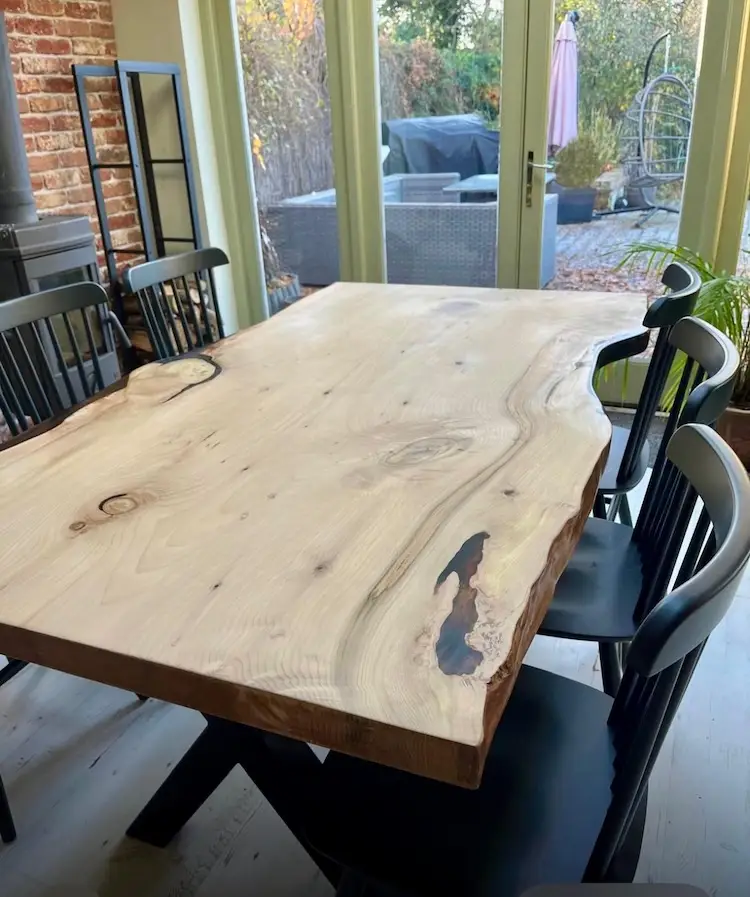
Live Edge vs Polished Concrete Dining Tables is a comparison post built to capture buyers choosing between premium table classes. This post defines the decision in spec-led terms — room fit, durability behaviour and aesthetic language.
This post captures buyers choosing between live edge timber and polished concrete. Both are premium statement categories, but they create totally different design outcomes.
How the classes differ
- Aesthetic language: live edge = organic warmth and grain; concrete = mineral monolith and uniformity
- Room feel: live edge softens modern spaces; concrete sharpens minimalist interiors
- Surface behaviour: timber needs correct finishing and habits; concrete needs sealing habits — both are easy when understood
- Commissioning: both succeed when size and base geometry are specified around real seating
Which one should you choose?
If you want organic grain and one-piece natural character, live edge wins. If you want a mineral monolith with modern uniformity, polished concrete wins. The correct choice is the one that matches your room scale, lifestyle and design language.
Where this post connects
Design your table
Every RockVine live edge table is built to order. Start at Live Edge Timber Dining Tables, explore customisations (timber species, finishes and bases), then get a quote. We’ll lock size, base geometry and slab selection around your room so every seat works.
Related live edge cities
- Shapes: round / oval
- Sizes: 8 seater
- Performance: stain / heat / scratch / care
- Pricing: prices / what affects price
- Finishes: colours & finishes
- Comparisons: vs epoxy river / vs solid wood
Frequently asked questions
Should I choose a live edge or polished concrete dining table?
Live edge timber gives organic character — natural slab profile, visible grain, warmth. Polished concrete gives architectural restraint — minimal lines, contemporary presence, monolithic feel. Choose live edge for warmth and natural character; concrete for modern minimalist or hospitality settings.
Which is more durable: live edge or polished concrete dining tables?
Polished concrete is harder, more scratch-resistant, more heat-resistant. Live edge timber is more forgiving of impact and can be sanded out and refinished if damaged. Both are exceptionally durable when properly built; the failure modes are just different.
Which costs more: a live edge timber table or a polished concrete table?
They overlap heavily. RockVine live edge tables start around £1,950; polished concrete starts at £1,395. Larger statement pieces in either material can run £4,000–£8,000+. Live edge can scale higher at the premium end due to rare slab availability.
Do live edge tables and polished concrete tables work together in the same room?
Yes — and beautifully. Many of our clients choose both for different rooms (e.g. concrete dining table and live edge breakfast bar, or live edge dining and concrete sideboard). The two materials sit alongside each other naturally.
Which is better for a family with young children?
Polished concrete is more forgiving of spills, marker pens and rough use due to its sealed, non-porous surface. Live edge timber is slightly more vulnerable to watermarks if spills sit, though our food-safe sealer handles everyday family life on either. Both perform well; concrete is marginally easier to maintain.
How long do live edge and polished concrete tables take to make?
RockVine polished concrete dining tables: 14 days for Slimline, 4–6 weeks for Premium, 8–10 weeks for Cloud sculpted. Live edge timber tables: 6–8 weeks typical, depending on slab availability. Both are built to order; we don't hold stock.
Related reading
Design your table. Get a price in minutes.
Use our Table Builder to configure your concrete, resin river, or live-edge table — or send us a full enquiry.
Get Your Quote