Date
06 Jul 25
Design your table.
Get a price in minutes.
Concrete, resin river, or live-edge — configure yours in our Table Builder.
Concrete vs Solid Wood Dining Tables – Which Is Actually Better?
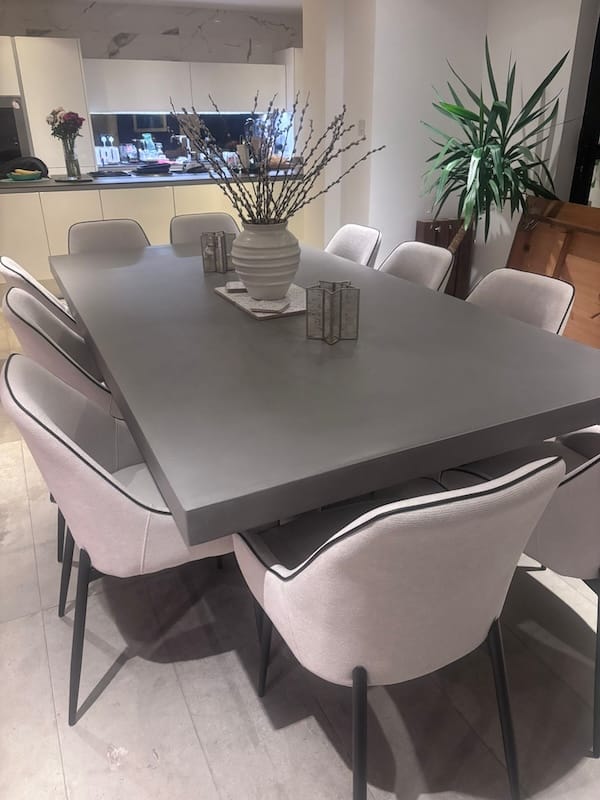
Choosing between a concrete or solid wood dining table is one of the most common dilemmas for UK homeowners designing modern living spaces.
Both materials look beautiful — but they behave very differently in everyday life.
This guide breaks down the facts so you can choose the table that truly suits your home, lifestyle and long-term expectations.
Durability & Daily Wear
Feature
Concrete
Solid Wood
Scratch resistance
Excellent
Moderate
Dent resistance
Excellent
Moderate
Water resistance
Excellent
Moderate
Long-term stability
Very high
Can move & warp
Concrete is far more resistant to dents, moisture and movement. Solid wood can expand, contract and mark over time — especially in kitchens.
Heat Resistance
Concrete
Solid Wood
Hot plates & pans
Safe
Risk of burn marks
Heat discolouration
No
Yes
Concrete wins decisively here.
Maintenance
Concrete
Solid Wood
Regular oiling
No
Yes
Stain sensitivity
Low
High
Water ring risk
Very low
High
Concrete requires almost no ongoing maintenance beyond normal cleaning.
Style & Aesthetics
Concrete
Solid Wood
Modern & architectural
★★★★★
★★★
Rustic & traditional
★★
★★★★★
Bespoke shapes & sizes
Excellent
Excellent
Both can be bespoke — but concrete leans architectural while wood leans rustic.
Cost Comparison (UK)
Size
Concrete
Solid Wood
1.8m
£1,800–£2,800
£1,200–£2,400
2.4m
£2,500–£4,000
£1,800–£3,200
Wood is usually cheaper upfront — but concrete often outlasts it.
Which Should You Choose?
Choose concrete if you want:
• Zero-maintenance living
• Heat and stain resistance
• Architectural modern design
• A table that will still look new in 10+ years
Choose solid wood if you want:
• Warm natural character
• Traditional interiors
• A lighter table
• You’re happy with maintenance
Final Verdict
Concrete dining tables deliver superior durability, heat resistance and long-term performance — while solid wood offers warmth and tradition.
For busy modern homes, concrete is increasingly the smarter long-term investment.
Frequently asked questions
Is a concrete dining table better than a solid wood dining table?
Neither is "better" — they suit different homes. Concrete dining tables are heavier, more architectural, more forgiving of stains and heat. Solid wood is warmer, lighter, and develops character through patina rather than concrete's subtle weathering. Choose concrete for modern minimalist or hospitality use; solid wood for traditional or rustic interiors.
Are concrete dining tables more durable than solid wood?
In raw durability terms, yes — properly engineered polished concrete is more scratch-resistant, heat-resistant, and stain-resistant than oak, walnut or ash. But solid wood is repairable in ways concrete is not — a deep scratch can be sanded out. Both last decades when looked after.
Which costs more: a concrete or a solid wood dining table?
They overlap heavily. Mid-range RockVine polished concrete dining tables start at £1,395; mid-range solid oak tables sit at similar pricing. Premium custom pieces in either material run £3,000–£8,000. Concrete tends to scale higher at the very top end due to base engineering complexity.
Do concrete dining tables feel cold compared to wood?
Concrete sits at room temperature in a heated home — no colder than stone or quartz. Wood feels marginally warmer to touch but the difference is subtle. Both are perfectly comfortable for daily dining; nobody refuses to sit at either.
Can I get a concrete dining table that mimics the wood look?
Not realistically. Some manufacturers texture concrete to suggest grain, but it never reads as wood. If you want timber character with stone-like durability, look at our live edge timber tables instead — solid hardwood with a kiln-dried, food-safe finish.
Which lasts longer: concrete or solid wood?
Both can last decades. Properly cured concrete tables won't crack, warp or fade for 20+ years. Solid hardwood tables can last centuries with periodic refinishing. The honest answer: both will outlast most homes if cared for.
Related reading
Design your table. Get a price in minutes.
Use our Table Builder to configure your concrete, resin river, or live-edge table — or send us a full enquiry.
Get Your Quote